St John Passion
If there were to be a popularity contest to decide on Johann Sebastian Bach’s greatest choral work, the St John Passion might well trail behind the B minor Mass, the Christmas Oratorio and, of course, the St. Matthew Passion. Shorter than the Matthew, cruder, less finely honed, it could be dismissed as little more than a rough draft for the much greater Matthew Passion.
The distinguished Bach conductor and scholar, Sir John Gardiner disagrees. In 2013*, he wrote of his belief that far from being dwarfed by its “epic companion piece”, it is in fact a more radical work. “Indeed,” he says, “it packs a more powerful dramatic punch than any Passion setting before or since.”
Bach uses, he says, “suspense and the satisfying arc of traditional narrative, including conflict, crisis and resolution, and sustains it at a pitch of musico-theatrical intensity beyond that of any opera score of the period… The cast-list includes clear-cut villains, a hero-cum-martyr, and secondary characters either likeable but flawed (such as Simon Peter) or merely flawed (Pontius Pilate); and yet, emphatically, it is not an opera… It is as bold and complex an almalgam of story-telling and meditation, religion and politics, music and theology as there has ever been.”
We are delighted and proud to be performing this magnificent music this Eastertide.
*Music in the Castle of Heaven published by Allen Lane 2013

We are pleased to thank our sponsor for this concert, Smith & Nephew.
The Lamentation of Christ
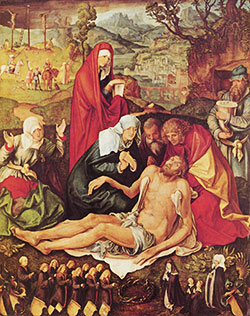
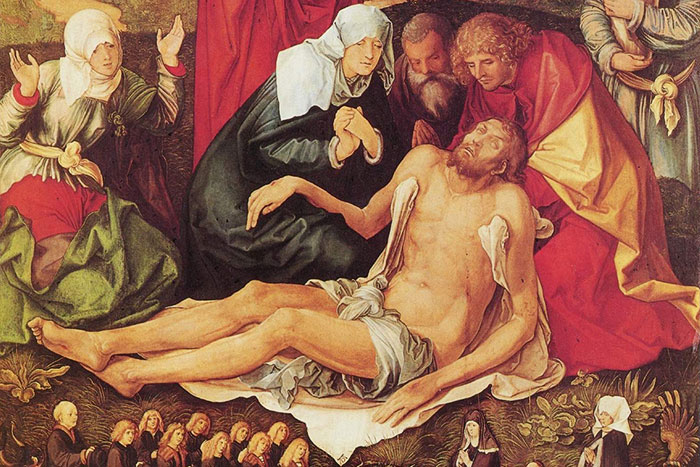
Our illustration at the top of the page shows the centre part of the Lamentation of Christ, attributed to the German Renaissance artist Albrecht Dürer. It is thought to have been painted in about 1498 for the family chapel of Karl Holzschuher in the church of Sankt Johannis in Nuremberg.
The centre of the painting is occupied by Jesus' dead body, supported by John the Apostle and lamented by Mary, Nicodemus and a pious woman. Dürer's monogram can be seen in the corner of Jesus' white shroud.
Beyond our selection, Mary Magdalene and Joseph of Arimathea stand behind, holding balms to prepare the corpse for burial. Below is the crown of thorns and, in tiny proportions, the depictions of the donors from the Holzschuher and Grüber families, accompanied by their coat of arms. The landscape in the background shows the Calvary, where two thieves are still hanging from their crosses.